
Buying or selling property involves much more than agreeing on a price and signing a contract. Behind every property transaction is a legal process that checks the property, confirms the rights and obligations of each party, manages the transfer of money and ultimately changes the registered ownership of the land.
That process is known as conveyancing.
For buyers and sellers in Victoria, understanding the conveyancing process step by step can make the entire transaction feel far less complicated. It can also help you recognise which documents matter, when important decisions need to be made, and where potential problems may arise before settlement.
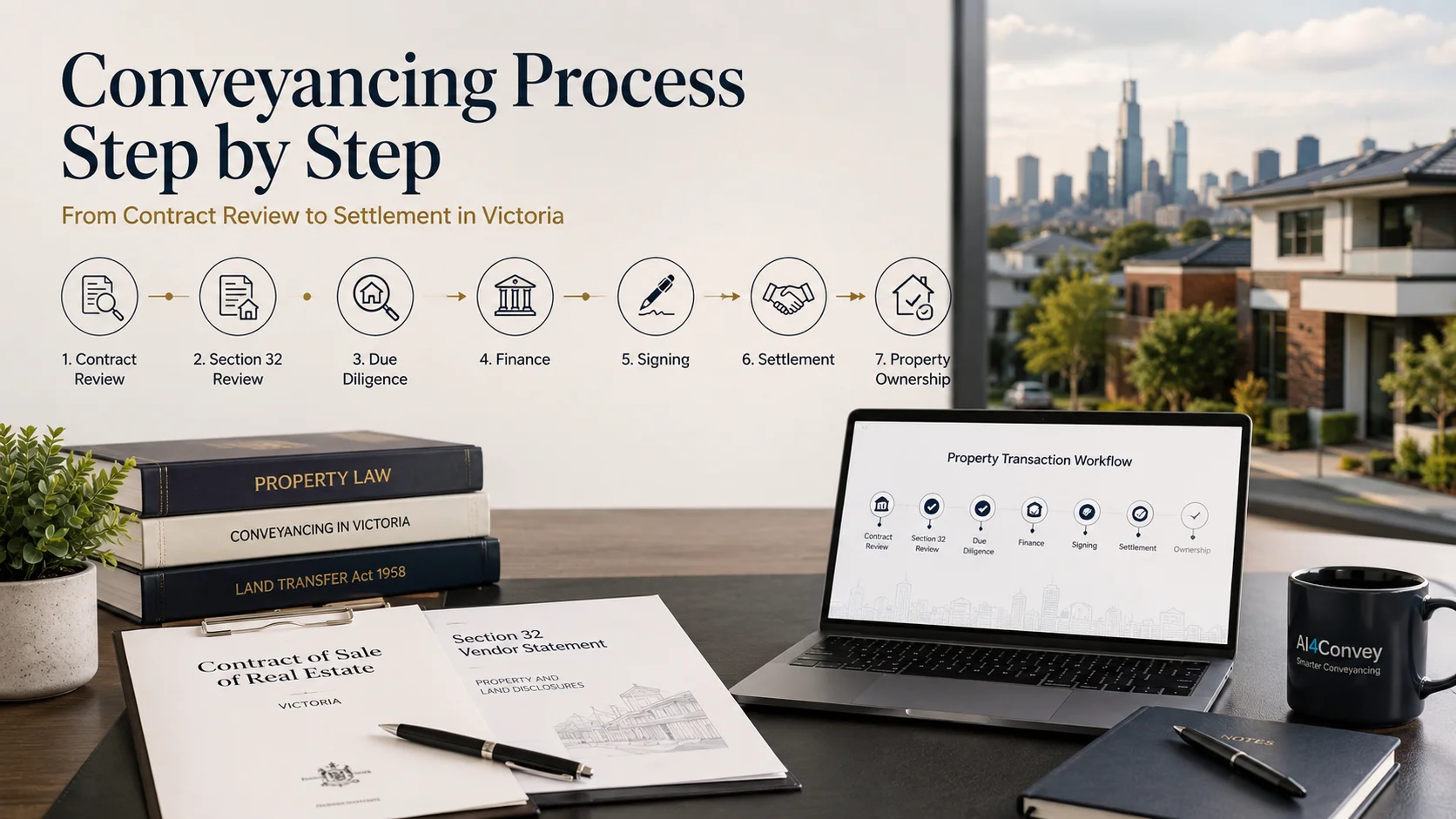
This guide explains how the conveyancing process in Victoria typically works, from the first contract review through to settlement and transfer of ownership.
What Is Conveyancing?
Conveyancing is the legal and administrative process involved in transferring ownership of property from one person or entity to another.
Although settlement is the point at which ownership formally changes hands, conveyancing starts well before settlement day. It usually involves reviewing the Contract of Sale and Section 32 Vendor Statement, checking the property title and relevant disclosures, managing contractual conditions, preparing transfer documents, calculating financial adjustments and coordinating with banks, estate agents and the other party’s legal representative.
For buyers, the purpose of conveyancing is largely about understanding exactly what is being purchased and ensuring the legal transfer is completed correctly.
For sellers, it involves preparing the property for sale from a legal perspective, making the required disclosures and completing the transfer once the buyer has fulfilled their obligations.
In Victoria, one of the most important documents in the process is the Section 32 Vendor Statement. The seller must provide this document to a prospective buyer before the buyer signs the Contract of Sale. It contains important information about matters such as mortgages, easements, covenants, planning controls, rates and other property-related obligations.
The Conveyancing Process Step by Step
Every transaction is slightly different. A straightforward residential purchase may move through the process relatively smoothly, while an off-the-plan purchase, development site, commercial property or contract with unusual special conditions may require significantly more investigation.
For a typical Victorian residential property transaction, however, the process generally follows these stages.
Step 1: Engage a Conveyancer or Property Lawyer
Ideally, a buyer should engage a conveyancer or property lawyer before signing a Contract of Sale.
Waiting until after signing can limit your options because you may already be legally committed to conditions that could have been identified or negotiated earlier.
Your conveyancer can review the contract, explain the legal consequences of its terms and identify issues that may require further investigation. They can also discuss whether conditions relating to finance, building inspections, pest inspections or other matters should be added before an offer is made.
For a seller, the process often begins earlier. A conveyancer or solicitor will usually be involved in preparing the Contract of Sale and Section 32 Vendor Statement before the property is offered for sale.
Starting early gives both sides more time to resolve issues rather than discovering them shortly before settlement.
Step 2: Review the Contract of Sale
Contract review is one of the most important parts of the conveyancing process.
A Contract of Sale contains much more than the agreed purchase price. It identifies the parties, describes the property being transferred, records the deposit and settlement date and establishes the legal terms governing the transaction.
It can also contain special conditions that substantially change the buyer’s or seller’s rights.
These conditions may deal with finance approval, building inspections, adjustments, penalties for delayed settlement, vacant possession, owners corporation matters, GST, property defects or requirements that must be completed before settlement.
A buyer should therefore avoid treating a contract as a standard form that simply needs a signature.
Two properties with almost identical sale prices can have very different legal considerations depending on what appears in the contract and supporting documents.
Step 3: Review the Section 32 Vendor Statement
For Victorian property transactions, reviewing the Section 32 Statement is a critical part of pre-purchase due diligence.
The document provides information that may affect how the property can be owned, occupied, financed or developed.
Depending on the property, it may disclose matters such as mortgages registered over the land, easements affecting the title, restrictive covenants, planning information, rates, taxes and other notices.
For example, an easement running through part of a residential block may affect where future extensions can be constructed. A restrictive covenant may limit certain forms of development. Planning controls or owners corporation obligations may also be important to a purchaser’s plans.
The Section 32 Statement does not, however, replace a physical inspection of the property. Consumer Affairs Victoria specifically notes that it does not provide information about the physical condition of buildings, building-regulation compliance or whether title measurements are accurate.
That is why legal document review and physical property due diligence should generally be treated as separate but complementary parts of the buying process.
Step 4: Complete Property Due Diligence
Once the contract documentation has been reviewed, the purchaser may need to conduct additional investigations.
The extent of due diligence depends heavily on the property.
For an established house, a buyer may arrange building and pest inspections. For an apartment or townhouse, owners corporation records may require closer attention. Buyers considering redevelopment may want to understand zoning, overlays, easements and other planning restrictions before committing.
Due diligence is particularly important before an auction because the normal ability to make an offer subject to conditions is considerably more limited.
A professional inspection can reveal physical issues that cannot be discovered simply by reading the Contract of Sale or Section 32 Statement. Consumer Affairs Victoria recommends buyers consider professional building and pest inspections and investigate issues that could affect their decision before purchasing.
Step 5: Negotiate the Contract and Special Conditions
If the property is being purchased through a private sale, the contract may sometimes be negotiated before signing.
This is the point where a buyer’s conveyancer or lawyer may suggest amendments to particular clauses or recommend adding conditions appropriate to the transaction.
A common example is a subject to finance condition.
If finance has not yet received unconditional approval, a properly drafted finance condition can be particularly important. Similarly, a buyer may want a private sale to be conditional upon a satisfactory building inspection.
There is no single set of conditions that is appropriate for every purchase. The right conditions depend on the property, the buyer’s circumstances and the negotiating position of each party.
This is one reason copying conditions from another transaction or relying solely on generic templates can create unnecessary risk.
Step 6: Sign the Contract and Pay the Deposit
Once the parties have agreed on the price and conditions, the Contract of Sale is signed.
In a private sale, the buyer will generally make an offer by signing a contract. When the seller accepts the offer and signs the contract, the transaction becomes binding, subject to any applicable cooling-off rights and contractual conditions.
The deposit is also paid in accordance with the contract.
A 10% deposit is common in Victorian residential property transactions, although there is no universal legal requirement that every transaction use the same percentage. The amount and timing should therefore always be checked against the particular contract.
At this stage, dates become especially important.
Finance deadlines, deposit dates, settlement dates and any other contractual milestones should be recorded and monitored carefully.
Step 7: Understand the Cooling-Off Period
For many private residential property sales in Victoria, buyers have a three clear business day cooling-off period.
The period begins based on when the buyer signs the contract, rather than when the seller signs it.
If a buyer exercises the cooling-off right correctly, they can withdraw from the purchase but will generally lose the greater of $100 or 0.2% of the purchase price.
However, cooling-off rights do not apply to every transaction.
For example, there are important exceptions relating to properties purchased at public auction or within the prescribed period before or after an auction, as well as certain commercial, industrial and rural transactions.
Because the consequences of signing can be significant, cooling-off rights should not be treated as a substitute for obtaining advice before committing to a purchase.
Step 8: Satisfy Finance and Other Contract Conditions
After signing, any conditions contained in the contract need to be dealt with within their specified timeframes.
For a buyer using finance, this usually means working with the lender or mortgage broker to move from preliminary or conditional approval to formal approval.
The lender may arrange a valuation and require further financial documents before confirming the loan.
Other contractual conditions may also need to be satisfied during this period.
If the purchase is subject to a building inspection, for example, the inspection needs to be completed within the contractual timeframe and any issue must be dealt with according to the wording of the relevant condition.
Simply missing a deadline can materially affect a party’s rights, which is why diary management is such an important part of professional conveyancing.
Step 9: Complete Title and Legal Checks
As settlement approaches, the conveyancer continues the legal and administrative work required to transfer the property.
The title and plan are checked, and relevant information is reviewed to ensure there are no unexpected changes affecting the property.
For the purchaser, this work helps confirm that the correct property interest is being transferred.
For the seller, existing interests such as a mortgage may need to be discharged as part of settlement.
Identity verification, client authorisations and electronic conveyancing requirements are also handled during this stage where applicable.
Victoria now relies heavily on electronic land transactions. Electronic conveyancing enables authorised professionals to prepare and lodge land registry instruments through approved Electronic Lodgment Networks, including platforms such as PEXA and Sympli.
Step 10: Prepare for Land Transfer Duty
Purchasers in Victoria generally need to pay land transfer duty, commonly known as stamp duty.
The amount payable depends on factors including the property’s dutiable value, how the property will be used and whether the buyer qualifies for an exemption or concession.
Different treatment may apply to first-home buyers, principal places of residence, foreign purchasers and certain other transactions.
Land transfer duty generally needs to be dealt with before the transfer of ownership can be registered, and the purchaser’s conveyancer, solicitor or bank will normally manage the duty process through Victoria’s digital systems.
Because duty rules and thresholds can change, buyers should calculate their expected liability using current information rather than relying on figures from an older property transaction.
Step 11: Calculate Settlement Adjustments
The purchase price is not necessarily the only amount that changes hands at settlement.
Certain property expenses are apportioned between the buyer and seller so that each party effectively pays their correct share.
This process is known as settlement adjustment.
Council rates and other relevant outgoings may be adjusted depending on what has already been paid and the settlement date.
For example, if the seller has already paid an applicable outgoing covering a period beyond settlement, the buyer may need to reimburse the seller for the buyer’s share of that period.
The final figures are calculated before settlement and incorporated into the amount required to complete the transaction.
Consumer Affairs Victoria notes that, at settlement, rates and other charges are adjusted between the parties, with responsibility changing according to the settlement date.
Step 12: Arrange the Final Inspection
A buyer should not assume that because the property looked fine several weeks earlier, there is no reason to inspect it again.
In Victoria, purchasers are entitled to inspect the property at a reasonable time during the week before settlement.
The purpose is not to renegotiate the purchase because of ordinary issues that were already visible when the property was bought.
Instead, the inspection is an opportunity to confirm that the property remains in the condition required by the contract and that included fixtures or other agreed items remain at the property.
If something has been damaged, removed or changed unexpectedly, the buyer should notify their conveyancer promptly so the issue can be addressed before settlement where possible.
Step 13: Prepare for Electronic Settlement
In the days leading up to settlement, several parties may be coordinating behind the scenes.
The buyer’s conveyancer, seller’s conveyancer, incoming lender and outgoing lender may all need to complete tasks before the transaction can settle.
The buyer must ensure sufficient funds are available to cover the balance of the purchase price together with relevant duty, adjustments and other required amounts.
The seller’s representative confirms the amount required to discharge any existing mortgage and prepares the transfer for completion.
Electronic settlement systems allow representatives and financial institutions to coordinate the financial settlement and electronic lodgment of the relevant land documents.
This is one of the reasons modern conveyancing can appear relatively quiet from the client’s perspective even though substantial work is taking place between signing and settlement.
Step 14: Settlement Takes Place
Settlement is the moment the transaction is completed.
The balance of the purchase price is transferred, relevant financial obligations are dealt with and the documents required to transfer ownership are lodged.
For most buyers, settlement is also the point at which they become entitled to take possession of the property unless the contract provides otherwise.
Once settlement has been confirmed, the buyer can generally arrange to collect the keys from the estate agent.
In Victoria, settlement periods commonly fall somewhere between 30 and 90 days, although the actual settlement date is determined by the Contract of Sale and can be shorter or longer depending on the transaction.
Step 15: Registration and Post-Settlement Matters
Settlement may feel like the end of the process, but there are still administrative steps occurring in the background.
The transfer of land is registered with the Victorian Land Registry through the relevant electronic lodgment process. Where a buyer has obtained a mortgage, the lender’s mortgage is also dealt with as part of the transaction.
Electronic instruments are checked against Victorian land registry data before lodgment and, following lodgment, are examined and registered or recorded through the Victorian system.
The buyer should also make sure practical matters such as insurance, utilities and property records have been updated.
For the seller, settlement means the sale proceeds have been distributed as required and ownership of the property has passed to the purchaser.
How Long Does the Conveyancing Process Take in Victoria?
There is no single conveyancing timeframe that applies to every Victorian property transaction.
For a standard residential sale, 30 to 90 days from contract to settlement is common, but the contract ultimately determines the settlement period.
The legal work itself begins before the contract is signed and continues until settlement and registration.
A transaction may take longer where there are unusual title issues, finance delays, complex special conditions, owners corporation problems, off-the-plan arrangements, deceased estates or other legal complications.
For this reason, the settlement period should not be confused with the total amount of professional work involved in conveyancing.
What Can Delay Property Settlement?
Many settlement delays are not caused by a single major problem. They often result from smaller issues being discovered too late.
Finance may not be ready. A mortgage discharge may still be outstanding. A document may contain incorrect information. Required funds may not have cleared. One party may not have completed an identity or signing requirement.
Complex contractual or title issues can create further delays.
Good conveyancing therefore depends heavily on preparation. The earlier documents are reviewed and important dates identified, the easier it is to deal with potential problems before they threaten settlement.
Why Contract Review Matters So Much
Much of the risk in a property transaction is established long before settlement day.
Once a contract has been signed, the legal position of both parties is largely determined by the contract’s general and special conditions.
A clause that appears routine may create an important obligation, deadline or limitation. Long Victorian Contracts of Sale can also contain numerous schedules, certificates and supporting documents, making manual review time-consuming for busy property professionals.
For conveyancers, reviewing these documents accurately and efficiently is therefore a major part of managing a transaction.
This is also where specialised technology is beginning to play a larger role.
Using AI in the Conveyancing Process
Artificial intelligence is increasingly being used to support document-heavy professional workflows, and conveyancing is particularly well suited to this type of assistance.
A Victorian Contract of Sale may contain dozens or even hundreds of pages. Reviewing those documents involves identifying relevant clauses, dates, obligations, property information and potential issues while ensuring important details are not overlooked.
AI4Convey is designed specifically to assist Victorian conveyancing professionals with this part of the workflow.
Rather than replacing the professional judgement of a licensed conveyancer or property lawyer, AI4Convey can support the review process by analysing Victorian property contracts and Section 32 documentation, extracting important information and highlighting clauses or issues that may require closer professional attention.
For conveyancers handling multiple matters at once, this can reduce repetitive document-reading work and make it easier to focus professional time on interpretation, advice and client service.
Buyer and Seller Responsibilities During Conveyancing
Although your conveyancer manages much of the legal process, buyers and sellers still play an important role.
Clients should provide requested identification and information promptly, disclose relevant circumstances, review documents sent for approval and make sure funds and finance arrangements are ready before required deadlines.
One of the simplest ways to create unnecessary settlement pressure is to ignore emails or postpone signing documents because settlement still appears to be several weeks away.
Conveyancing works best when the client, conveyancer, lender and estate agent communicate early rather than trying to resolve outstanding matters on settlement day.
Frequently Asked Questions About the Conveyancing Process
What is the conveyancing process in Victoria?
The conveyancing process is the legal process used to transfer ownership of Victorian real estate from a seller to a buyer. It typically includes contract and Section 32 review, property and title checks, satisfying contract conditions, preparation of transfer documents, calculation of settlement adjustments, land transfer duty and electronic settlement.
When should I hire a conveyancer?
Buyers should ideally engage a conveyancer before signing a Contract of Sale or bidding at auction. This gives the conveyancer an opportunity to review the contract and Section 32 Statement before the buyer becomes legally committed.
Sellers generally engage a conveyancer or solicitor before marketing the property so the Contract of Sale and Section 32 disclosure documents can be prepared.
What is a Section 32 Statement?
A Section 32 Vendor Statement is a disclosure document that a Victorian seller must provide to a prospective purchaser before the purchaser signs the Contract of Sale.
It contains important information about the property, including matters such as title interests, mortgages, covenants, easements, planning information and certain property outgoings.
How long does conveyancing take in Victoria?
A typical residential settlement period is often between 30 and 90 days, although the exact period is determined by the Contract of Sale. Some transactions settle sooner while more complex transactions may take considerably longer.
Can a buyer cancel a property contract after signing?
Sometimes.
A three-clear-business-day cooling-off period generally applies to qualifying private residential property sales in Victoria, but there are important exceptions, particularly around auctions and certain categories of property or purchaser.
Contractual conditions such as finance may provide additional rights depending on their wording and circumstances.
A buyer considering ending a contract should obtain professional legal advice rather than assuming a cooling-off or contractual right automatically applies.
What happens on settlement day?
On settlement day, the remaining purchase funds are transferred, adjustments and other financial obligations are completed and the documents required to transfer the property are lodged through the electronic conveyancing system.
Once settlement has been completed, the purchaser can generally take possession of the property and collect the keys unless another arrangement has been made.
Is conveyancing in Victoria electronic?
A significant proportion of Victorian land transactions are now handled electronically through approved Electronic Lodgment Networks. Platforms operating within Victoria include PEXA and Sympli for applicable transactions.
A Smoother Conveyancing Process Starts With Better Information
Conveyancing may appear to be a straightforward journey from signing a contract to collecting the keys, but every successful settlement depends on numerous legal, financial and administrative checks being completed correctly along the way.
For buyers, understanding the process means knowing what you are agreeing to before becoming legally committed.
For sellers, it means preparing accurate documentation and ensuring the property can be transferred without unnecessary complications.
For conveyancing professionals, it means managing contracts, deadlines, disclosures and client obligations efficiently across multiple matters.
Technology can make parts of that work significantly easier.
AI4Convey is built specifically for Victorian conveyancing professionals, helping streamline Contract of Sale and Section 32 review by extracting key information, identifying relevant clauses and supporting faster document analysis.
The technology does not replace professional legal judgement. Instead, it gives conveyancers another tool to reduce repetitive review work and spend more time on the issues that genuinely require their expertise.