
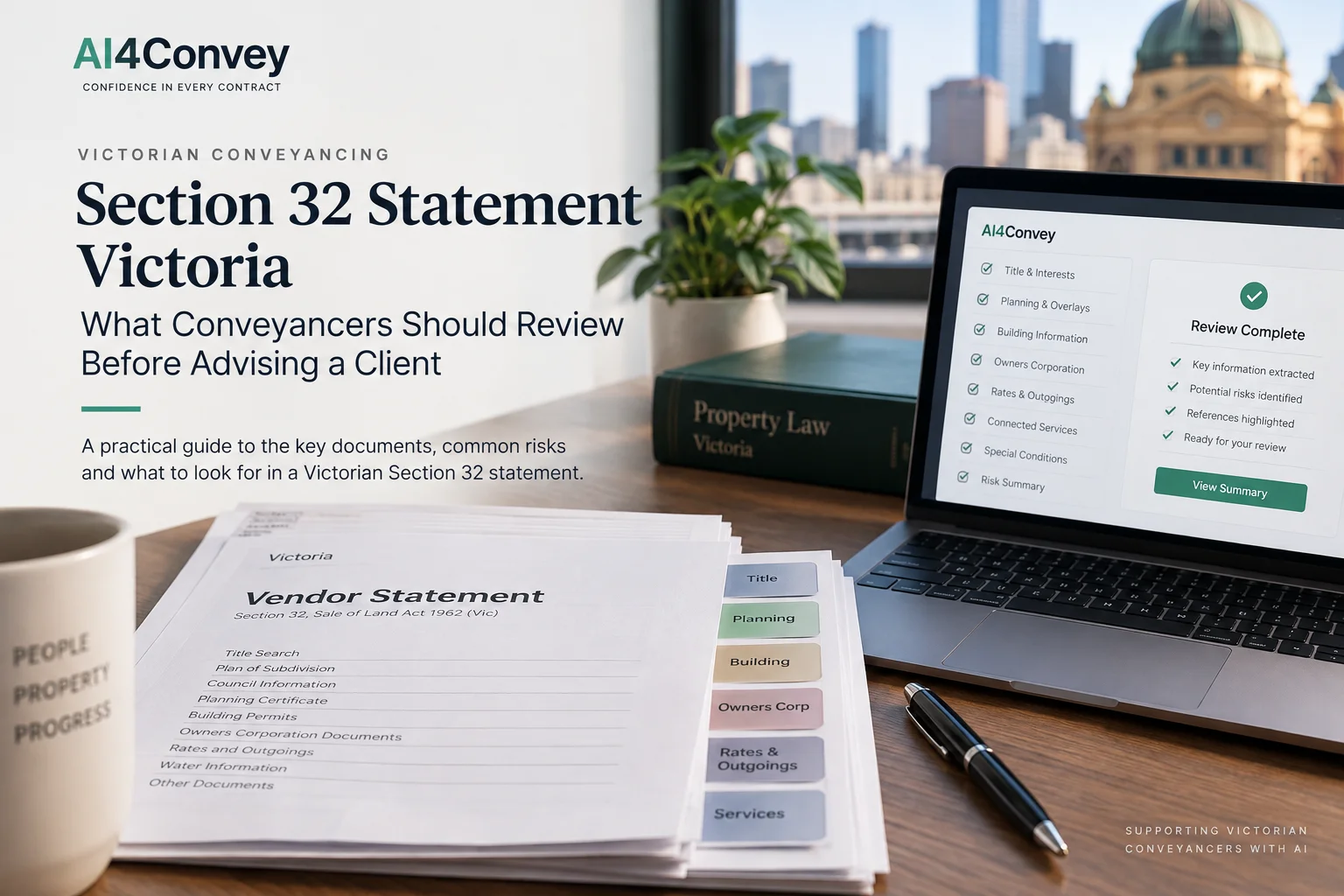
A Section 32 statement can look deceptively routine.
For an experienced conveyancer, many of the documents inside a vendor statement will be familiar: title searches, plans, council information, water certificates, planning information and, where relevant, owners corporation documents. That familiarity can make a Section 32 feel like a standard part of the pre-contract process.
But the real work is not confirming that a document is present.
It is understanding what the documents say when they are read together, identifying information that does not match, recognising restrictions or liabilities that matter to the purchaser, and deciding what requires further investigation before a client signs a contract.
In Victoria, the vendor must provide the purchaser with a signed Section 32 statement before the purchaser signs the contract of sale. The disclosure obligations arise under the Sale of Land Act 1962 (Vic), and Consumer Affairs Victoria makes clear that the statement must be factually accurate and complete.
For conveyancers, that makes Section 32 review more than a document-reading exercise. It is an early risk assessment of the property and the transaction.
What is a Section 32 statement in Victoria?
The Section 32 statement, often called a vendor statement, is the disclosure document provided by the seller to a prospective purchaser before the purchaser enters into the contract.
Its name comes directly from section 32 of the Sale of Land Act 1962.
Depending on the property, the statement can contain information about title, mortgages, easements, covenants, planning controls, rates and other outgoings, building permits, owners corporation matters, services and other interests or restrictions affecting the land.
What it does not provide is equally important.
A Section 32 is not a building inspection. It does not, by itself, tell a purchaser that the building is structurally sound. Consumer Affairs Victoria also notes that it does not necessarily establish whether buildings comply with building regulations or whether measurements shown in title-related material are physically accurate on the ground.
This is why a useful pre-contract review needs to go beyond summarising the vendor statement.
The question is not simply, “What does the Section 32 contain?”
The better question is, “What does this information mean for this purchaser and this property?”
A good Section 32 review starts with the title
Before getting drawn into the volume of certificates attached to a Section 32, it is worth establishing exactly what land is being sold.
The title search and plan provide the foundation for the rest of the review. The registered proprietor should make sense in the context of the transaction. The lot and plan details should correspond with the property being marketed. Mortgages, caveats, covenants, easements and other registered interests need to be identified and then followed through where necessary.
A title reference to an easement or restrictive covenant should rarely be treated as the end of the enquiry.
The wording of the underlying instrument can be much more important than the notation appearing on the title itself.
A drainage easement may affect where a purchaser can build. A restrictive covenant may limit the number or type of dwellings permitted on the land. A registered agreement may contain obligations that are not obvious from an abbreviated title notation.
LPLC has specifically identified drainage easements, covenants and missing supporting information as recurring sources of Section 32-related claims. Its current guidance recommends checking whether the document describing each relevant restriction has actually been obtained and included.
For a purchaser thinking about an extension, subdivision, redevelopment or even a new garage, this can be more commercially important than several pages of standard contract wording.
Easements and covenants need interpretation, not just identification
It is common to see property reviews that simply report:
“The title is affected by an easement.”
That tells the client very little.
The next question is what the easement is for, where it sits, what rights it creates and whether it affects the purchaser’s intended use of the property.
The same applies to restrictive covenants.
A covenant affecting the land may have little practical impact on one purchaser and be critical to another. Someone buying an established home with no development plans may view a restriction differently from a purchaser intending to construct a second dwelling or substantially alter the site.
The review therefore needs context.
If the client’s plans are known, restrictions should be considered against those plans rather than described in isolation.
LPLC’s 2026 guidance also warns that not every relevant easement is necessarily obvious from the title. Unregistered drainage or service arrangements can create problems, which is one reason water and encumbrance information can be important when checking the disclosure against the physical property.
Planning information should answer a practical question
Planning information is another area where simply naming the zone does not amount to meaningful advice.
A purchaser usually wants to know whether there is something about the planning position of the land that could affect how they intend to use it.
That may involve zoning, overlays, bushfire-related information, heritage controls or other planning restrictions.
The significance of those controls changes from transaction to transaction.
For a client buying a suburban home to occupy, the issue may be fairly limited. For a developer, investor or purchaser planning major works, the planning information may be one of the most important parts of the Section 32 review.
A useful review therefore distinguishes between information that is technically present and information that may have a practical consequence.
This is also where the Section 32 should be treated as the beginning of due diligence rather than the end of it. If the purchaser has a development objective, further planning or property advice may still be required before they commit.
Check public authority information for what has changed
Section 32 disclosure is not limited to what appears on title.
Information from councils and other authorities can reveal matters that require closer attention, including notices, orders, proposals or other issues directly affecting the land.
A certificate should not be treated as background paperwork simply because it is a standard attachment.
Dates matter. References matter. Differences between what the vendor has said and what an authority certificate records matter.
LPLC recommends comparing vendor instructions against the searches and certificates rather than preparing or reviewing the disclosure in separate silos.
That comparison is often where problems become visible.
A property described one way by the client may look different when council, water, planning and title records are considered together.
Rates and outgoings deserve more than a quick scan
For many residential transactions, council rates and water charges are expected and relatively straightforward.
Even so, financial disclosures should still be read in context.
The reviewer should be alert to charges, taxes or liabilities affecting the land and to information that could influence settlement adjustments or the purchaser’s ongoing ownership costs.
Owners corporation fees are particularly relevant for apartments and other strata-style properties because the headline annual fee rarely tells the whole story.
A purchaser may be more concerned about whether additional liabilities, major works or unusual financial pressures exist than about the ordinary quarterly contribution.
The purpose of reviewing outgoings is not merely to repeat a dollar figure already visible in the certificate. It is to recognise anything that appears unusual, material or inconsistent with the rest of the transaction.
Building permits can reveal a bigger story
Building information deserves particular care where the property has recently been renovated, extended or substantially altered.
Under the Victorian disclosure framework, relevant building permits issued during the previous seven years may need to be disclosed where there is a residence on the land. LPLC also warns practitioners not to stop at asking whether a permit was obtained. The more useful question is whether building work was carried out at all.
That distinction can expose owner-builder issues.
A beautifully renovated home may appear straightforward from the marketing photographs while the legal documentation tells a more complicated story.
The review should therefore consider whether recent works appear consistent with the available building information and whether further documentation or enquiries may be required.
This is one of the clearest examples of why automated extraction alone is not enough. Finding the words “building permit” in a PDF is useful. Understanding why the permit matters in the context of the sale is the real professional task.
Owners corporation properties require a different level of attention
When a property is affected by an owners corporation, the Section 32 review becomes more layered.
Consumer Affairs Victoria notes that relevant owners corporation material forms part of the disclosure process, and purchasers may need to consider current owners corporation information rather than relying indefinitely on older documents.
For a conveyancer, the important question is not simply whether an owners corporation certificate has been attached.
Its contents need to be read.
Fees, insurance, rules, recent resolutions and information about the operation of the owners corporation may all change the purchaser’s understanding of the property.
The phrase “inactive owners corporation” also deserves care. It should not automatically be interpreted as meaning there are no owners corporation issues to consider.
LPLC’s current guidance highlights the relationship between owners corporation activity, insurance and disclosure, particularly where common property exists.
For the client, this information can translate into something very practical: future cost, restrictions on use, insurance exposure or the likelihood of dealing with shared-property decisions after settlement.
Connected services can produce surprisingly serious errors
Electricity, gas, water, sewerage and telecommunications may appear to be among the simpler parts of a vendor statement.
They are also an area where assumptions can be dangerous.
LPLC reports recurring claims involving incorrect information about connected services, with sewerage being a notable example. A property having a functioning toilet does not necessarily mean it is connected to a reticulated sewer system; a septic system may be operating instead.
This becomes particularly important for regional, semi-rural and fringe metropolitan properties.
If information in the Section 32 does not sit comfortably with the nature or location of the property, that inconsistency deserves attention.
Good review work frequently comes down to noticing something that does not quite make sense.
The contract and Section 32 should be reviewed as one transaction
Reviewing the Section 32 without reviewing the contract of sale can leave important questions unanswered.
The vendor statement explains matters affecting the property. The contract governs the transaction being entered into.
The two documents need to be read together.
A title restriction may become more significant when considered alongside the purchaser’s proposed use. A disclosure about an owners corporation may interact with settlement timing or adjustments. A property issue identified in the vendor statement may require a special condition, further investigation or advice before the purchaser signs.
Special conditions themselves also need careful attention.
Standard wording can be relatively predictable. Additional special conditions drafted specifically for the transaction deserve closer scrutiny because they may alter rights, impose deadlines, shift risk or change what happens if a particular event occurs.
A useful pre-contract review therefore does not produce two disconnected summaries titled “Contract” and “Section 32”.
It produces a single understanding of the transaction.
How current is the Section 32?
One of the most common practical questions is how long a Section 32 remains valid.
There is no simple universal expiry date that automatically makes the entire statement invalid after a fixed number of days. What matters is whether the disclosure remains accurate and complete when it is provided to the purchaser.
The difficulty is that the documents supporting the Section 32 are dated.
A title can change. New interests can be registered. Rates and charges can change. Owners corporation information can become outdated. A property that has remained on the market for a long period may therefore deserve a closer look than a newly prepared disclosure.
Consumer Affairs Victoria specifically notes that Section 32 statements may sometimes have been prepared many months before a sale and recommends obtaining updated owners corporation information or inspecting current records where appropriate.
The date on the front of the vendor statement should never be the only measure of whether the information can safely be relied upon.
What happens when a Section 32 is incomplete or inaccurate?
A defective Section 32 is not simply an administrative inconvenience.
Consumer Affairs Victoria warns that incorrect or insufficient disclosure can give a purchaser rights to withdraw from the sale or take legal action, depending on the circumstances.
For practitioners acting for vendors, defective statements can also create professional risk.
LPLC states that it continues to receive claims involving defective Section 32 statements and considers many of those claims preventable through better systems, accurate information gathering and proper checking of the statement against supporting searches and certificates.
That is an important distinction.
Section 32 risk is often not created by an obscure point of law. It can arise from a missing document, an incorrect assumption, outdated information or a fact that appeared in one part of the file but was not connected with another.
Where AI can help with Section 32 review
A typical Victorian contract pack can be long.
Much of the review time is spent locating relevant information across title documents, certificates, plans, special conditions and the vendor statement itself.
This is an area where AI-assisted contract review can be genuinely useful.
A system can identify documents, extract key information, locate references to easements and covenants, flag special conditions, surface owners corporation information and help a practitioner navigate a large contract pack more quickly.
The real value is not replacing legal judgment.
It is reducing the amount of time spent finding the information that judgment needs.
For example, an AI review may identify that a title refers to a restrictive covenant, that an owners corporation certificate is included, or that a special condition changes a standard contractual position. The conveyancer can then focus on determining the significance of those findings for the client.
That distinction matters.
Property transactions are contextual. Two clients can receive the same Section 32 and require different advice because their intentions, risk tolerance and plans for the property are different.
AI works best as part of the review process, not as a substitute for the practitioner responsible for the advice.
From document review to risk review
The most useful way to think about a Section 32 is not as a collection of certificates.
It is a map of issues affecting the property.
The title may reveal restrictions. Planning information may affect future use. Building records may raise questions about recent works. Owners corporation documents may reveal obligations that continue long after settlement. Service information may expose assumptions that need to be verified. The contract may then determine how those issues interact with the purchaser’s legal position.
For conveyancers handling multiple files, the challenge is doing this consistently while still moving quickly.
Technology can make that process faster. Good systems can make it more reliable. Neither removes the need for professional judgment.
The goal is not simply to review a Section 32 faster.
It is to reach the important questions sooner.
Can a purchaser sign a contract before receiving the Section 32?
The Victorian disclosure regime requires the vendor to provide the signed Section 32 statement before the purchaser signs the contract of sale.
This timing matters because the purpose of the statement is to allow the purchaser to consider relevant information about the land before becoming contractually committed.
Where the required disclosure has not been properly provided, the consequences should be considered carefully against the Sale of Land Act and the circumstances of the transaction.
Is the Section 32 the same as a contract review?
No.
The Section 32 forms part of the broader pre-contract review, but it does not replace review of the contract of sale.
A purchaser needs to understand both the property being acquired and the contractual terms governing the acquisition.
The strongest review process considers the contract, Section 32 and supporting documents together rather than treating them as unrelated documents.
Who should review a Section 32 in Victoria?
A purchaser can ask a Victorian legal practitioner or licensed conveyancer to review the Section 32 and contract before purchase. Consumer Affairs Victoria expressly recommends obtaining professional assistance with conveyancing documentation because of the legal and financial consequences involved.
For practitioners, AI-assisted review can provide an additional layer of document analysis, particularly when contract packs are lengthy, but final advice should remain with the qualified professional responsible for the matter.
A better way to approach the next Section 32
A careful Section 32 review should leave the practitioner with more than a summary.
It should create a clear picture of the land, the restrictions affecting it, the matters that require further investigation and the issues the client needs to understand before signing.
That is where a combination of good conveyancing practice and well-designed technology becomes valuable.
AI4Convey is built to assist Victorian conveyancing professionals with the first-pass review of property contracts and Section 32 documents, helping surface relevant clauses, property information and potential issues within large contract packs.
The practitioner still decides what matters.
The technology helps them find it sooner.
This article provides general information about Victorian conveyancing and does not constitute legal advice. Legislative requirements and individual transactions can change, and practitioners should refer to the current legislation and professional guidance when advising a client.